


March 4, 2026
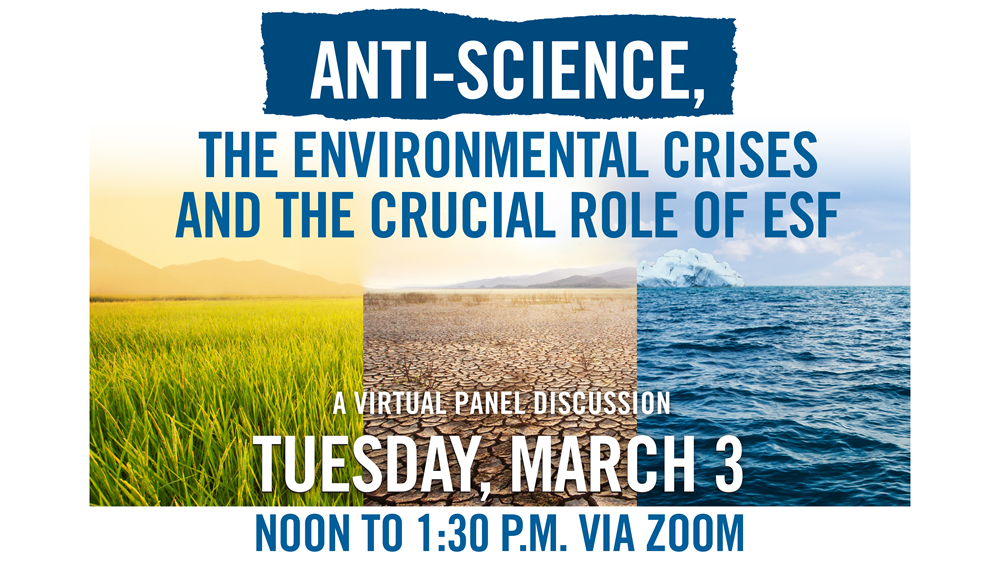
The need for solid financial support of the SUNY College of Environmental Science and Forestry and the next generation of environmentalists has never been stronger, as states and the federal administration upend decades of climate research and policy.
That was the consensus of a panel of experts and advocates convened by UUP and the National Wildlife Federation March 3 for a virtual forum on the value and future of what panelists called the “crown jewel” of the nation’s environmental colleges—which is based in Syracuse but has a national reputation. The forum drew more than 250 people, many of them UUP members.
UUP President Fred Kowal, who moderated the forum, opened the forum by praising ESF, whose graduates have “become stewards of public lands.”
Funding gap threatens nationally renowned college
Kowal, who also chairs the National Wildlife Federation’s Board of Directors, is leading UUP’s campaign against a state cost-cutting plan at ESF that has resulted in dozens of experienced faculty taking a retirement incentive and budget cuts for graduate students. Most of ESF’s long-running financial problems could be solved if the state would plug an $8.3 million gap in the college’s operating budget, Kowal told a panel of state lawmakers during budget testimony Feb. 24.
“If there’s ever been an institution that needs public funding, it’s ESF,” Kowal told the audience.
All five panelists have ties to ESF. They were Collin O’Mara, National Wildlife Federation president and chief executive officer, and a Syracuse native who took classes at ESF in high school and graduate school; Robin Kimmerer: director emeritus of the ESF Center for Native Peoples and the Environment and a best-selling author; Rita Hite, an ESF alumna and president and chief executive officer of the American Forest Foundation; Rick Fedrizzi, a member of the ESF Board of Trustees and founding chair and former CEO of the U.S. Green Building Council; and ESF student Dan Vera, president of the Mighty Oak Student Assembly.
ESF role heightened by federal withdrawal
The panelists talked about the role of ESF following the federal administration’s Feb.12 announcement that it is repealing the Greenhouse Gas Endangerment Finding of 2019. The Endangerment Finding, a study that established the harmful effects of greenhouse gases on human health and the environment, was the foundation on which the federal government’s environmental policies have been based.
“The work of ESF can help people make sense of the world around them,” O’Mara told the audience. “Folks are still hungry for trusted information. The way you overcome misinformation is by open communication.”
“Everywhere I go, people praise and recognize ESF,” Kimmerer said. “Bridging the gap between reality and the world we live in has always been the role of education. We are an institution driven by the values of science.”
“People are starting to understand that the government is not going to do this for you,” Fedrizzi said, in referencing the need for the private sector to continue environmental policies that the government has abandoned. “People are taking this on themselves in a really positive way.”
Fighting to protect ESF now, and for the future
UUP plans to continue advocating for ESF through the legislative session and beyond. Members have sent thousands of letters to lawmakers, asking them to close ESF’s budget deficit.
Panelists closed with their own pleas to the governor and the Legislature..
“We’re great students who are impassioned about the world,” Vera said. “Imagine what the world would look like if ESF had all the funding a support that we really deserve?”
Said Kimmerer, “If New York state wants to retain its reputation as a leader in the environmental arena, then fund ESF.”